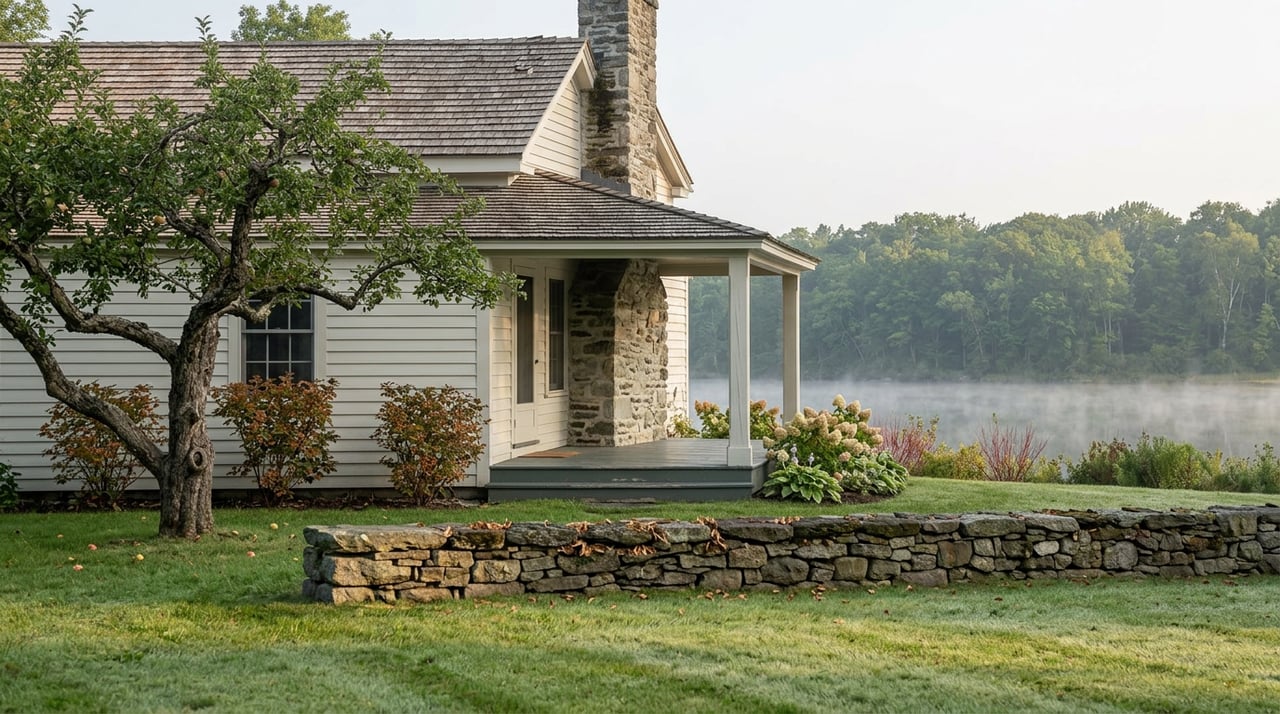
How does a town's median home price fall by nearly half in a single year without a single house losing value?
That's what the numbers suggest happened in Westport, New York. Over the three months ending May 2026, the town's median sale price came in at $700,000, down 48.2 percent from the same stretch a year earlier. Read on its own, that looks like a market in free fall. Read next to Essex County's broader trend, and next to what's actually parked along this stretch of shoreline, it looks like something else entirely: a handful of very different houses closing in a very small sample, doing what small samples do.
If you're comparing towns along Lake Champlain rather than shopping a single listing, this matters more than any one number on a portal page. Westport, Essex, and Willsboro sit within about fifteen minutes of each other on the same lake. Their median prices, days on market, and buyer profiles diverge sharply anyway, and not for the reason most people assume.
The Number That Doesn't Mean What It Looks Like
Essex County as a whole posted a median sale price of $271,000 in August 2025, with homes selling in a median of 53 days, down from 64 days the year before, on just 51 recorded sales that month. Fifty-one sales across an entire county is not a large sample. Break that county down to a single town in a single quarter, and you're often looking at a handful of transactions, sometimes fewer than ten.
That's the mechanical reason Westport's median can swing 48 percent without reflecting any real shift in value. If two or three high-end lakefront estates close in one three-month window and a cluster of modest inland homes close in the next, the median moves dramatically even though no individual property changed in worth. A median is a description of whoever happened to sell, not a valuation of the town.
This is the trap of comparing shoreline towns using headline numbers alone. The lake doesn't get 48 percent less valuable in a season. The sample just got smaller and different.
Same Lake, Three Different Answers to "How Do I Get Here"
Once you set the statistical noise aside, there's a real and durable reason these three towns behave like different markets: each one solves the access problem differently, and that access shapes who buys there.
Westport has a train. The town's Amtrak station was built in 1876 by the Delaware and Hudson Railroad, expanded in 1891 and again in 1908, and sold to the town for one dollar in 1974 when the railroad no longer needed it. It now houses the Depot Theatre, a professional summer stage established in 1979 inside the old depot building. Amtrak completed accessibility and platform upgrades at the station in October 2024. The Adirondack line that stops there runs from New York's Moynihan Train Hall to Montreal, putting Westport within a single-seat train ride of Manhattan. For a buyer who wants a lake house without a car-dependent commute, that's not a lifestyle amenity. It's the whole reason Westport draws a different bidder than the towns around it.
Essex has a ferry instead. The Essex-Charlotte crossing has run since 1826 and takes about 25 to 30 minutes to reach Charlotte, Vermont, with two boats operating in summer for more frequent departures and a single boat through the winter, weather and ice permitting. That's a different kind of access. It doesn't connect Essex to New York City. It connects Essex to Burlington's job market and airport on the Vermont side of the lake, which shapes a buyer profile oriented toward Vermont commuting or day-tripping rather than weekend rail travel from downstate.
Willsboro has neither, and that's part of its story. Founded in 1799, it's the oldest lake town in the county, built around the protected bay formed by Willsboro Point. There's no train stop and no ferry dock here. What there is instead is a marina and dining economy: Indian Bay Marina and Restaurant and Safe Harbour Marina both sit on Willsboro Bay, and Turtle Island Café has been recognized by the New York Times as one of the area's better restaurants. Noblewood Park offers lake, mountain, and river views along with paddling and camping access, and Rattlesnake Mountain is a well-known local day hike. Recent property records put Willsboro's average home price at $253,953, roughly 35 percent below the county average, which tracks with a town that competes on boating and dining rather than transit.
The Access Question Sorts Buyers Before the Price Does
| Town | Access infrastructure | Defining local anchor | Recent price signal |
|---|---|---|---|
| Westport | Amtrak Adirondack line stop, direct to NYC/Montreal | Depot Theatre (est. 1979) inside the 1876 station | 3-month median $700K, ending May 2026, but on thin volume |
| Essex | Essex-Charlotte ferry to Vermont, seasonal schedule | Historic hamlet, ferry-oriented commerce | Tracks broader county figures; small sample by nature |
| Willsboro | No rail or ferry; marina-based | Willsboro Bay marinas, Turtle Island Café, Noblewood Park | Average home price ~35% below county average |
This is the part a portal search doesn't surface. A buyer choosing between these three towns isn't really choosing between three price points. They're choosing between a train commute, a ferry commute, and no commute infrastructure at all, and the prices follow from that choice rather than the other way around. A downstate buyer who wants to leave the car behind gravitates toward Westport and will pay for that convenience regardless of what the county median says. A buyer oriented toward Vermont's job market or Burlington's airport looks at Essex. A buyer who wants a boat slip, a strong local dining scene, and the lowest entry price on this stretch of shoreline lands in Willsboro.
What This Means If You're Comparing Towns, Not Just Prices
If you're shopping this part of the Lake Champlain region with a portal's county-level median open in one tab, close that tab first. A county figure blends a rail town, a ferry town, and a marina town into one number that describes none of them accurately. Ask instead what kind of access matters for your life: a train platform, a ferry schedule, or neither. That question will tell you more about which town fits than any median will.
It also means a low headline price in a given quarter, or a startlingly high one, deserves a second look before you read it as a trend. With sale counts this small, one estate closing or one starter cottage closing can move the number by a third or more without the underlying market having done anything at all.
FAQ
Does having an Amtrak stop actually make Westport homes worth more? It's one factor among several, not a guarantee on any single property. What it does reliably do is widen the buyer pool to include people who want lake access without year-round car dependence, which is a real and durable demand driver distinct from the town's raw square footage or lot size.
Why did Essex County's median drop even though days on market also dropped? Those two numbers can move independently. A faster median time on market points to healthy demand for whatever inventory was available. A falling median price often reflects which properties happened to sell in that window, not a broad discount across the county.
Is Willsboro actually the cheapest place to buy on this stretch of Lake Champlain? Based on average home price, yes, it currently sits well below the county average. That reflects the absence of a rail or ferry premium more than any difference in the lake itself. Buyers who prioritize a marina and a strong local food scene over a commute connection tend to find the best value here.
Every one of these towns sits on the same body of water, and every one of them prices differently for reasons that have nothing to do with the lake. If you're weighing Westport's rail access against Essex's ferry or Willsboro's marina economy, that's exactly the kind of comparison Bob Miller Real Estate works through with buyers every season. Contact Bob for a local market consult before you let a single town's median make the decision for you.